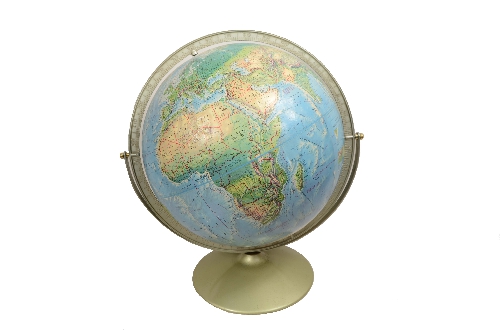
1784986862Code 8560 Terrestrial GlobeGlobe published in the 1920s by French geographer J. Forest; in addition to the territorial map, it depicts ocean currents and the main trade routes of the period.
Papier-mâché and plaster sphere covered with lithographic printing paper segments, turned and ebonized wooden base.
Good condition, some signs of use, very good legibility. Dimensions: 19 x 39 cm – 7.5 x 15.4 in.
J. Forest created a wide variety of globes in the late 19th and early 20th centuries, primarily for educational purposes. His diverse production included table globes, some on turned and ebonized wooden bases, floor globes, and innovative globes, such as those with mechanically rotating bases or globes that incorporated lighters.
The Paris meridian was defined on June 21, 1667 by mathematicians of the Académie, but the measurement of the meridian was completed only in 1718 by Giovanni Domenico Cassini and his son Jacques Cassini. In 1740, César-François Cassini corrected the line, and the meridian was then remeasured from 1792 to 1798 by Jean-Baptiste Joseph Delambre and Pierre Méchain, as a basis for establishing the exact length of the meter in 1799. The Paris meridian was abandoned in favor of the Greenwich meridian at the Washington International Conference of 1884. Some of the reasons were that there was almost no inhabited land at the antipodes of Greenwich, the British promise to adopt the metric system in exchange for France's renunciation of the Paris meridian, and the fact that at the time, most nautical cartography was of English origin, and therefore adopting a meridian other than Greenwich would have required the replacement of a greater number of nautical charts. In France, the Greenwich meridian was not officially adopted until 1911.
The first recorded terrestrial globe is the one attributed by Strabo, historian and geographer, to the Greek Crates of Mallo (c. 150 BC). The first globes, constructed in the early 16th century under the impetus of great geographical explorations, immediately began to be used for educational purposes in princely courts, monasteries, and colleges; the globe later began to conquer universities and high schools. In the 18th century, Didier Robert de Vaugondy, the official geographer of King Louis XV of France, drawing on his experience in globe-making, expanded the Encyclopédie article "Globe" by detailing the distinction between a celestial globe (which represents the concave surface of the sky with its constellations) and a terrestrial globe (which represents the surface of the Earth with its seas, islands, rivers, cities, etc.) and the techniques for making them: two papier-mâché hemispheres were pressed and shaped on or inside a hemispherical mold, dried and strengthened on the inside with a wooden board, then glued and covered with a thin layer of plaster. The globe's meridians, usually twelve in number, were glued onto the meridians. The meridians were made of paper previously printed by copperplate engraving and colored, each covering 30 degrees of longitude. It was with the nineteenth century, marked by widespread trade, circulation, and the introduction of compulsory education, that the desire to explore distant lands increased, making the old method of globe construction inadequate. Printed globes from engraved plates were no longer sufficient, and the only real resource became lithography, which made it possible to print and promptly update maps that, with the growth of geographical discoveries in various countries, became increasingly obsolete.